Posts

Artisan, Fuji PXG4 and the Coffee-Tech FZ94: auto-tuning with beans

Afbeelding
1kg of beans rolling inside the FZ-94 Last weekend we added a Fuji PXG-4 PID to the FZ-94 roaster, Marko Luther provided the configuration of Artisan to facilitate this and we allowed the Fuji to autotune with an empty drum, finding the P, I and D variables to manage the heating elements in order to keep a perfectly stable temperature as measured in the upper Bean Temperature probe. Aborted Next, I gave it a try with a 1.2kg batch of beans but had to abort because the beans got quite hot while the Fuji was calmly analysing the temperatures and I wanted to keep the process within a safe margin. Beans were dropped at a Tonino #106 value so they were not really dark yet. 1kg load, 40% flow Tonight I prepared a load of 1kg of beans and I set the airflow to 40% capacity with a drum speed of 60%. Below is a screen snapshot of the full Artisan control panel with all sliders, LCDs and pre-roast buttons. It's all pretty basic for anyone who has roasted beans before. Full scr...

Espazzola group head cleaning tool

Afbeelding
Works very well! YouTube version:

Artisan adding Fuji PXG4 PID to the Coffee-Tech FZ94 roaster

Afbeelding
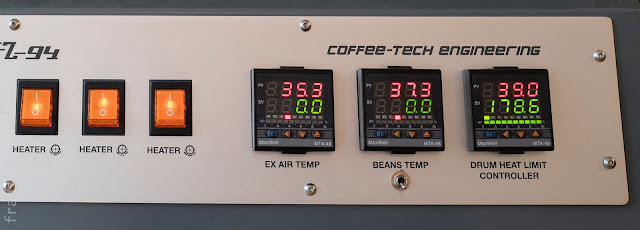
3 heater switches and 3 PIDs on Coffee-Tech FZ-94 front Plenty of Controls Ever since Artisan and the Coffee-Tech FZ94 joined forces, a lot of communication and control is already available to roastmasters. Much about the latest options adopted by Coffee-Tech in cooperation with Marko Luther of Artisan  have already been published on the Artisan blog for everyone to study and implement. Specifically, most details are described on Marko Luther's blog entry Playing with the CTE lab roaster and the sub-blogs linked there. Three PIDs, two drives All three PIDs on the front panel communicate with Artisan using the MODBUS ring and its USB connector. Furthermore, the two motors inside the roaster are connected over the same medium so one can use sliders in Artisan to speed up or slow down the airflow or drum rotation at every time during the roast process. Frequency drive controllers, operated from within Artisan Software PID The built in PID of Artisan can even be...

La Pavoni lever pin roller upgrade

Afbeelding
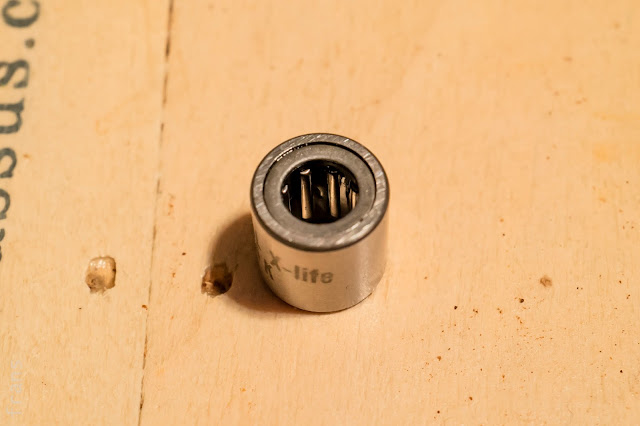
On the Facebook group for La Pavoni owners, Imsung Yoo recently showed how he replaced the lever pin roller with three small bearings and two washers. When I asked Tije de Jong if he could find a similar solution, he came up with this and it works very well, creating a more smooth lever motion: Small and nifty bearing Old pin roller out New bearing in Circlip ready to click in Done

Gothot's La Coronita centrifugal roaster

Afbeelding
This morning I chanced upon footage and pictures of a vintage roaster, currently owned by LI-MING machinery (Lin T / Joe Lin) in Taiwan who are restoring the machine for use as a sample roaster. It's magnificent, looking like a machine out of an eighties sci-fi movie: One of these machines was built in 1983 and sold by SHP Food Machinery in 2011. These pictures are on their website : La Coronita by Gothot Hot air blown in from the top, a cone spreading the flow, pushing beans up along the curved walls, past the curved blades, back to the center. When Jan van der Weel and I visited PROBAT some time ago, we saw a huge version of their roaster based on the same principle.  A former employee in our tour group explained to us that at the time, this 'flying saucer' shaped giant enabled the roasting industry to save lots of time and energy roasting as thousands of kg's of coffee beans would be ready in as little as three minutes....

BT Probe switch for FZ94

Afbeelding
After Tije made a custom BT probe for the Coffee-Tech FZ94 roaster  which fits in the spot of the trier, I have been using that probe almost exclusively because it shows the BT better during the initial phase of the roast (no "Turning Point" as the hot probe cools and meets up with the warmed up beans) and it measures a higher temperature towards the end, thus allowing greater display precision. Two BT probes: one inserted in the "trier" location, one next to the looking glass Recently, when roasting small samples of 200g together with Arnoud of Hoofdkwartier roastery, we observed that it was less easy to read a stable BT and we thought that the default lower placed probe could be a better one to monitor small batches. Yesterday Tije came over and he added a little switch to the control board allowing us to decide, before or during a roast, which BT probe to use: Up/down switch installed to select Beans Temp probe location to read from, the lower or uppe...

Kruve it

Afbeelding
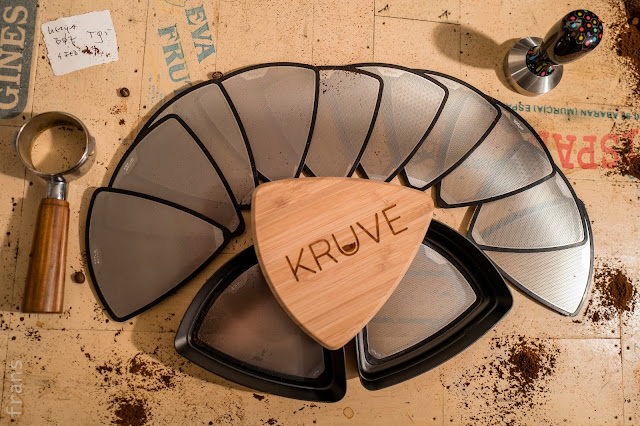
KRUVE sifter with set of precision sieves Fresh coffee grinds are a mesh of sticky multiformed particles. One could put them through a sifter like the one above to see what size they (mostly) are if they are moved around / agitated enough on the sifter's precision sieves to disintegrate into these particles.  An excellent grinder produces grinds within a mixture of sizes that allows a good flow and the best, most expressive, taste.  With t his set of sieves one could possibly decide what is the spread of particles sizes. Then, selecting and using a particular size, one could maybe 'improve' the grinds.  On the other hand, messing with the fresh grinds for several minutes instead of promptly making an espresso would be detrimental to quality. I like the look and feel of these tools but I have put them all back in the box.  Maybe someday I will want a tool like that and then I can take it out again.