My new Compak E8 grinder arrived just in time for Xmas. I have no tree and anyway it would not fit under the tree so I took out my sebenza and cut the box open, unpacking and installing the machine. I expect to put 10-20kg through the grinder before really putting it to the test. Jan van der Weel and I have promised a review for KTC magazine to appear in the spring 2016 issue. So there's time!
Below the list of pictures is a video of a first shot of espresso after dialing in the grinder to find the "espresso" grind, aiming for 30g of espresso in 30 seconds from 18g of grinds in the VST 18g portafilter basket, tamped with the LONDINIUM tamper and extracted on the Londinium L1-P lever machine, monitoring the flow with an Acaia Lunar coffee scale.
This specific grinder has the Lucidate "Red Speed Burr" set for lower friction and lower temperature.
A Box
Opened Box
Hopper popping out
First peek at the machine
Ready for action
Red Speed Burrs
Posing
Hopper filled
Sister E8 next to Big Brother R120
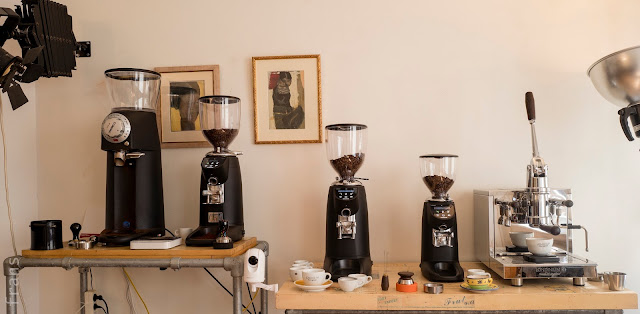
Grinder table ready, next to the little ROK (far left) and the larger HG One (far right)
Can't really say yet. I just unpacked and installed it. Jan and I will test and review in January. The first shots look and taste great though! I have not even methodically compared R120 and HG One inside-by-side shots yet. Could be nice to even do a ROK / E8 / R120 / HG One compare, measuring extraction % in shots that all were 30g in 30s from 18g. Later.
Roasting coffee beans, you want to be as consistent as you can, replicating a successful roast while collecting enough data (besides what you see, feel, smell and taste from the coffee) to get an idea what you may be doing wrong if the results are not so good all of a sudden. The Artisan software for coffee roasters has a feature to help you keep track of volume and density of your beans. Density is a word for the weight of a certain volume of beans and it can be measured in grams per liter. Your green beans are obviously more dense than the roasted beans: roasted beans have grown a lot in size and they have lost weight (moisture) in the process. In his new book “ The Coffee Roaster’s Companion ”, the famous Scott Rao explains these things: “Ideally, water should account for 10.5%-11.5% of green-coffee weight.” (p.3) “Coffee loses 12-24% of its weight during roasting, depending on initial moisture content, roast degree and inner-bean development during roasting. T...
(also see Daily Coffee News feature ) Tije designed and made the following structure for a tiny and cheap fluid bed roaster, to which Jan van der Weel added the Arduino parts, electronics and programming: Sketch by Tije de Jong Jan sourced a very cheap blower (€ 11) to start with, Tije developed and constructed the mechanics, Jan built together and programmed the TC4 / SSR electronics. On his blog, Jan will specify exactly how the TC4 part is combined and programmed and I will copy these details into this blog entry, just as Jan will use this video in his blog. We did a few test roasts to make sure it works at all and it does. Towards the end, the first roast tended to get a flat BT line and airflow was slightly decreased. 200g seems max load of green beans. Second roast a little more power was given to the heater. Next we will try the Background Roast driven by the PID software of Artisan. A week later, with updated software that works better to change the...
COMPAK models R120, E8, E6 and E5 lined up next to LONDINIUM L-R First impression, notes after a visit from Roemer Overdiep: Roemer came over to taste espressos from all 4 grinders. We made sure to every time have 18g in the 18g VST basket, using the distribution tool, getting about 30g of espresso in about 30s. R120 was best, E8 ‘redspeed’ almost as good, the E6 and E5 were somewhat similar in that the espresso was excellent but in comparison with E8 / R120 it has more ‘sharpness’ — the R120/E8 were softer, more subtle. If someone has excellent beans, an excellent espresso can be prepared with the E5 and only if one also has the bigger E8 nearby would one notice there might be something extra in buying the bigger grinder. Difference between E5 and E6 seems minimal. These tests were done with a first roast of Kenya beans. We poured the beans from the hopper of one grinder to the other while testing and gradually the hippers got emptier. Data about these 4 different sizes gri...


Reacties