Posts

Mandheling Roast on FZ94: Sliding Along the Roast Curve
Afbeelding
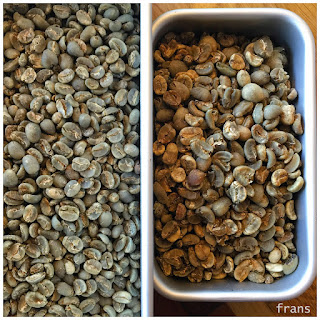
In March last year I wrote about roasting Indonesian beans from Sumatra . These Mandheling beans needed a lot of sorting before the roast but the result was delightful. This year I bought a 60kg bag of Mandheling from a different source, Het Hoofdkwartier in Amstelveen and this shipment was much cleaner. There are very few beans to sort out and I was excited to see how these would roast and taste best. To compare the two, this is a picture of last years's Mandheling: And this year's Mandheling: This was also a good time to explore the "power slider" roast method that was recently enabled with the help of Tije de Jong who installed three SSR's inside the control space of the FZ94 roaster and Marko Luther who built this slider option into Artisan , creating the option to control the PID in such a way that the slider on the computer screen changes the intensity of the heat coming from the three heating elements below the rotating drum inside the FZ9...

Cupping Central American beans

Afbeelding
A wide choice of recent crops of Central American beans were cupped this afternoon at Evermore Thee Koffie Chocolade , Coolhaven 158, 3024 AL Rotterdam. Importer: The Coffee Quest Coffee Imports .

Variable pre-infusion pressure works well on the L-R

Afbeelding
Today the variable pre-infusion pressure on the Londinium L-R came in very handy. I aim my roast to be consistently of about the same roast intensity, measured in a roast color acquired over a certain time. Mostly color Tonino #95 with a 15 minute roast. With a new bean it takes some time to tweak the roast profile and with a Sumatra bean I roasted the first batch rather dark, Tonino #83 even. That's not exceptionally dark compared to many beans sold in shops, they are not oily for instance beyond a tiny spot here and there on a few beans. But these Indonesian semi-washed beans which tend to have lots of 'body' already behave like dark beans, with a faster flow. Before, I would send these to a friend that I know who finds that really dark beans work best in her automatic coffee machine. Now I tried them myself and I find it yields delicious spicy earthy coffee with lots of body even when using just the 15g VST basket instead of the 18g basket that I mostly ...

PID settings on the Tiny Fluid Bed Roaster

Afbeelding
by Tije de Jong Trial and error A few days ago I made a first successful attempt to improve the PID settings on the roaster. I’m certainly not an expert in this: I have only a faint idea of how a PID works, and what the effect is of each of the P, I, D-vaues. Therefore, a bit of trial and error seemed the best way to go for me. The settings I had been using since we fist got the roaster to work  (P=1.0  =I=0.5   D=0.0), didn’t lead to the desired controllable roasting process. In particular during the drying phase, where the inclination of the profile is rather steep, I had to slide the background back and forth in order to get the machine on the right track. Once passed dry end, the system gained some stability. D for derivative I was told that the P-value could be regarded as the gas throttle of the machine. The function of the I and D were still a mystery to me. At first I tried increasing the I, which gave a slight better control, but still not ...

LONDINIUM Stirrer: a Preview

Afbeelding
Stirred

Power slider for Coffee-Tech FZ94: Artisan expanded

Afbeelding
Slider low for modest heat radiation (illustration by Tije de Jong) --- Slider high for intense heat radiation (illustration by Tije de Jong) ON or OFF In the default configuration, each of the three heating elements of the FZ-94 roaster can be switched on and off individually and in many cases this provides a good level of control already. Gradual effect Since it takes some time for an element to get up to full radiating power after it is first switched on and since it gradually decreases heat radiation after it is switched off, this enables a cautious and understanding operator to strategically switch elements on and off for a smooth effect on the roast. For instance, switching off the centre element and increasing air flow 25 seconds before the anticipated temperature surge of First Crack would mostly work to prevent an overshooting Bean Temperature early in the development phase right after FC. The fiery one in the middle The heating element in the middle is also ...